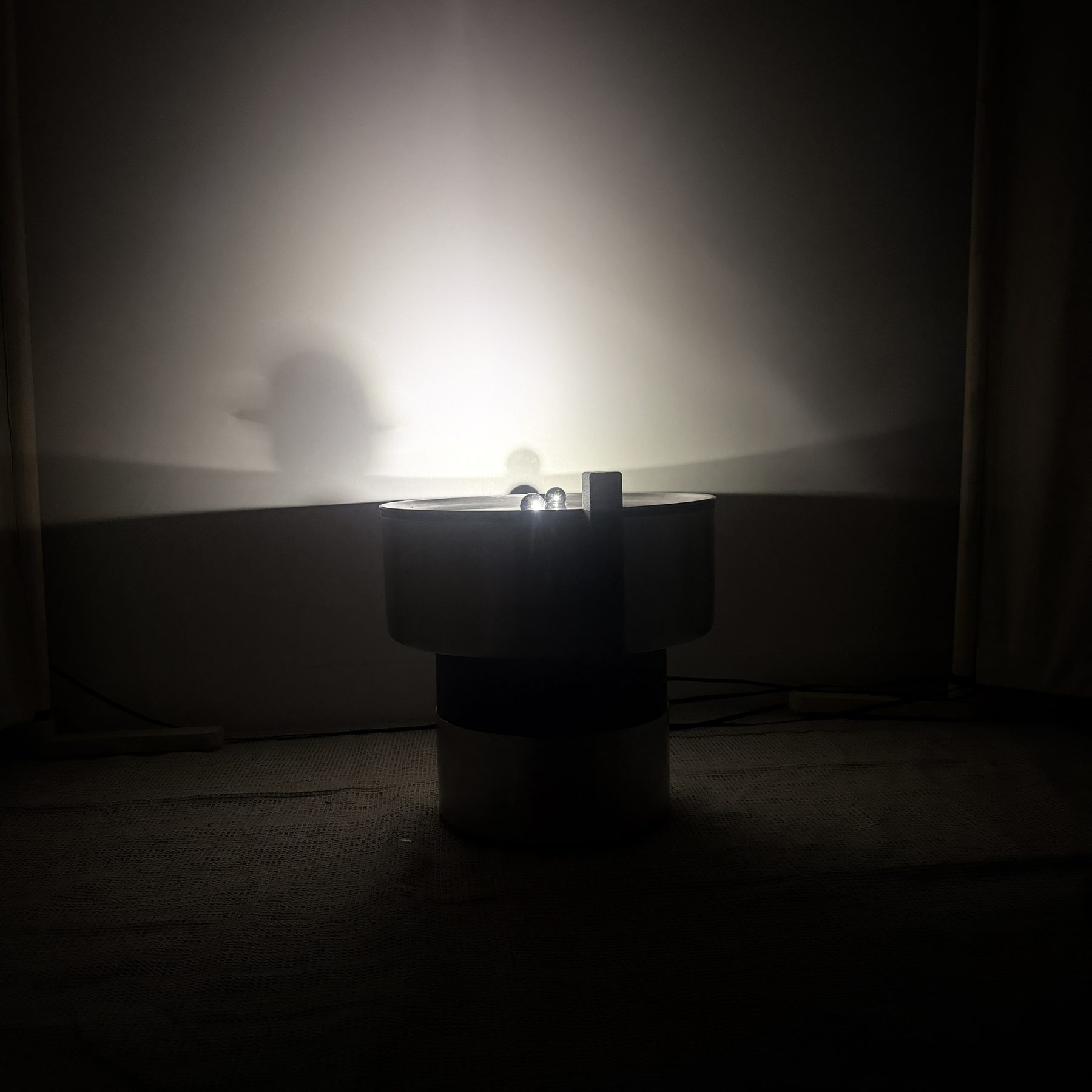
YIN
- Year
- 2026
- Phenomenon
- Breath, respiration
- Type
- Kinetic sculpture
All living things rely on some form of cellular respiration to stay alive. YIN makes this process visible through kinetic feedback driven by a chest-mounted dynamometer, sensing the rising and falling of your chest in real time. As you inhale, the two balls follow an arcing path inward; as you exhale, they arc outward. The distance the balls move is proportional to the depth of the breath you take, giving you immediate feedback on your breathing.
YIN is the first piece in a series exploring our shared need to respire. The work promotes stillness, drawing viewers back into their immediate sensory experience.
How it works
The dynamometer measures the chest’s expansion as force. Because every body breathes differently, the signal is normalized to each participant with an adaptive envelope, and the inhale and exhale phases are detected from how the signal is changing rather than from fixed thresholds.
Development
YIN was developed in three stages. It began in software, proving out the breath sensing and tuning the kind of motion I wanted before building anything. The first physical version moved the balls with motorized faders. They proved too weak to keep the balls magnetically coupled, and keeping the faders’ position tracking and motor control in sync made the system overly complex. The final version simplifies this to a single high-quality brushless DC gimbal motor, controlled over CAN bus, that drives both balls through a simple gear train; it took several iterations to get the gear tension, magnet size and magnet distance right. The balls themselves raised a materials problem: they have to be steel to couple strongly with the magnets, but steel left in water for a full day begins to rust. During the exhibition I solved this by adding baking soda to the water, which makes it slightly alkaline and slows corrosion.
YIN was shown at the MIT Media Lab in 2026 as part of the FAB26 conference. It is a small-scale precursor to a series of works that reflect a participant’s internal state (breath, heart rate, movement) as motion.
The finished piece proved extremely reliable, but the interaction had a weak point: I needed to stand by to help each participant put on the chest dynamometer at the right tightness so it gave a stable reading. The goal had always been to move to camera-based sensing, and in November 2026 I proved out a thermal camera system that reads breath without contact. I am now integrating it into the original work, making YIN a fully non-contact biosensing piece.